Invalid email address
Free Influencer Marketing Series
Success! Enjoy the series! Part 1: How an agency took a brand from 0 to $1MM in 4 months using influencers & ads
Free Influencer Marketing Series
Success! Enjoy the series! Part 1: How an agency took a brand from 0 to $1MM in 4 months using influencers & ads

See how MightyScout tracks your creator & UGC campaigns
Book a DemoThe formula
Earned Media Value (EMV) is MightyScout's standardized way of assigning a dollar value to influencer content, based on the estimated advertising equivalent of that content's reach or engagement. Before we get into why we rebuilt it, here's exactly how the number is calculated today:
CPM rates by platform
Rather than applying a single flat rate across all content, we use platform-specific CPM (cost per thousand impressions) rates to reflect the real-world differences in advertising value across social networks:
$10
CPM
$10
CPM
TikTok
$5
CPM
YouTube
$20
CPM
EMV formula by media type
The formula depends on the type of content being evaluated.
Videos
Views × platform CPM ÷ 1,000
For any video post where view data is present — YouTube videos, TikToks, Instagram Reels, and Facebook videos — this directly reflects the content's actual reach at the platform's corresponding CPM rate.
Static Posts & carousel posts (Instagram / Facebook)
(Likes + Comments + Shares) × 8.7 × platform CPM ÷ 1,000
View data isn't natively available for static image posts and carousels, so EMV is estimated from engagement signals. The 8.7 multiplier converts engagement count into an estimated view equivalent before applying the CPM rate.
Stories
Follower count × 3% × platform CPM ÷ 1,000
Story view data is often unavailable, so reach is estimated as a slice of follower count.
Global rules
Regardless of media type or formula used, two caps apply to every tracked post:
Minimum EMV
$25
Every tracked post or story is worth at least this much, ensuring no content registers as zero-value.
Maximum EMV
$10M
A ceiling applied to prevent outlier viral content from distorting aggregate reporting.
Previous Methodology
Prior to June 24, 2026, MightyScout used a single flat $35 CPM applied uniformly across all platforms and content types. Videos used actual view counts, while photos and stories estimated reach as a percentage of follower count (20% for standard posts, 10% for stories). There was no minimum EMV floor, meaning low-engagement posts could calculate to $0. The primary shortcoming was that it overvalued TikTok content, where real CPMs are much lower, and undervalued YouTube relative to market rates. Everything below is the story of why that had to change.
Earned Media Value is one of the most-used numbers in influencer marketing, and one of the least understood. Marketers put it on slides, defend budgets with it, and report it up the chain — and most of the time, the number underneath is built on assumptions so crude that two nearly identical posts can come out 30x apart.
We know, because we used to calculate it that way too.
This is the story of why we tore our EMV formula down to the studs and rebuilt it — and, more importantly, what we learned about what EMV is actually for in the process. Because you can't fix a number until you're honest about what it's supposed to measure.
01 The purpose
Marketing has always trusted the numbers it doesn't have to argue for.
A generation ago, paid meant print, broadcast, billboards — channels with standard, stated rates nobody questioned. Then digital arrived, and for a while a line item for online ads did raise eyebrows; a marketer asking for budget to run banner or search ads was making a case. That era is over. Today, saying "we want to put $500 into Meta or Google" doesn't get a second look. The cost is objective, the channel is established, and the value is taken on faith because the number is stated plainly and the medium has earned its seat.
Influencer, creator, and UGC marketing haven't been handed that same default respect — and we're well over a decade in. The work is no longer new. But "we want to put $500 into this creator campaign" still tends to invite a question the Meta line never gets: worth it? based on what? Not because the value isn't there, but because earned media doesn't arrive pre-packaged in a number the way a paid channel does. No auction handed you a price. So when you go to express the value, you're starting from scratch — and starting from scratch reads as softer than stating a rate everyone already accepts.
That's the gap EMV exists to close. It gives earned media the same legibility paid channels get for free — translating the reach and attention a creator generated into a defensible dollar figure, in the same unit every other channel already reports. So influencer work can finally be set next to paid media and compared apples to apples, instead of being waved off as the soft line item. EMV answers a specific question: what would it have cost to buy this much reach and attention through paid media?
That last part matters, and it's where a lot of formulas go wrong.
02 The benchmark
The intuitive shortcut is to value an influencer post at whatever the influencer was paid. Don't. Influencer rates are subjective — they're set by negotiation, by how sophisticated a creator's rate card is, by whether they have a manager, by how much budget the brand walked in with, by the relationship. Two creators with identical audiences and identical performance can command wildly different fees for reasons that have nothing to do with the value the post actually delivered.
(And to be clear: influencer marketing is not inherently "organic" or "free." It's frequently paid. The distinction that matters for measurement isn't paid vs. unpaid — it's negotiated, subjective pricing vs. observable, market-set pricing.)
That's exactly why EMV benchmarks against paid media instead of against the creator's invoice. Paid media rates are market-clearing and observable — an impression costs what the auction says it costs. The influencer's fee is an opinion. The paid benchmark is a market price. If you want an apples-to-apples read on what earned media was worth, you anchor to the objective thing.
03 The distinction
This is the most common and most damaging mix-up, so let's draw the line clearly.
ROI asks: what did we get back for what we spent? It's the bottom-line, attributable, dollars-in-dollars-out question — and it is rightly one of the most important metrics in all of business. We are not here to diminish ROI.
But ROI has a blind spot with influencer and brand work. A large share of the value a creator produces — awareness, social proof, the content itself, audience exposure — is real but not cleanly or immediately attributable, especially for top-of-funnel and brand initiatives. So if ROI is the only lens you measure the channel through, influencer marketing looks underpowered next to channels that attribute neatly — not because it produced less, but because last-click math literally can't see most of what it produced.
EMV is the metric that makes that value visible. Put simply:
ROI tells you what the campaign returned.
EMV tells you what the work was worth.
 MightyScout
You need both. Treat EMV as if it were ROI and you'll over-credit the channel. Ignore EMV entirely and you'll under-credit it — and you'll lose the budget argument to channels that simply attribute more easily. EMV gives earned media a currency so it can compete fairly, get evaluated as a real channel, and earn its place in the mix rather than getting cut first when budgets tighten.
So that's the job. Here's where the industry — and we — fell short of it.
04 The problem
If EMV is supposed to estimate what reach would have cost in paid, then the formula lives or dies on two things: how accurately you estimate the reach, and how accurately you price it. The standard industry approach — and our old formula — fumbled both.
The clearest symptom showed up the day we looked at two posts side by side. One was a static post from a mid-sized creator. The other was a video from an account more than ten times larger. Their actual engagement was similar. Their EMV was roughly 30x apart. One post was being valued at a small fraction of what it was plainly worth, while another sailed past any defensible number.


That's not a rounding error. That's a formula measuring the wrong things.
The root causes were the kind of crude assumptions that hide inside almost every EMV calculation in the industry:
Each of these was an invisible assumption doing enormous work in the final number. And because they were invisible, nobody questioned them — including us.
05 The rebuild
We stopped guessing and went to the data. We analyzed posts across platforms and formats to answer the questions the old formula had been waving away: How is reach actually distributed for a static post versus a video versus a story? What does a view actually cost on each platform? Where are the existing assumptions wildly off?
Price by platform, not with one blanket rate.
A view is worth what the market pays for that view, on that platform. Different platforms, different rates. Defensible, and intuitive to anyone who's bought media.
Estimate reach from real distribution data, by format.
Static posts, videos, and stories travel through the algorithm differently. We model each from observed behavior in our data instead of forcing them all through one proxy.
Recognize the value of the asset itself.
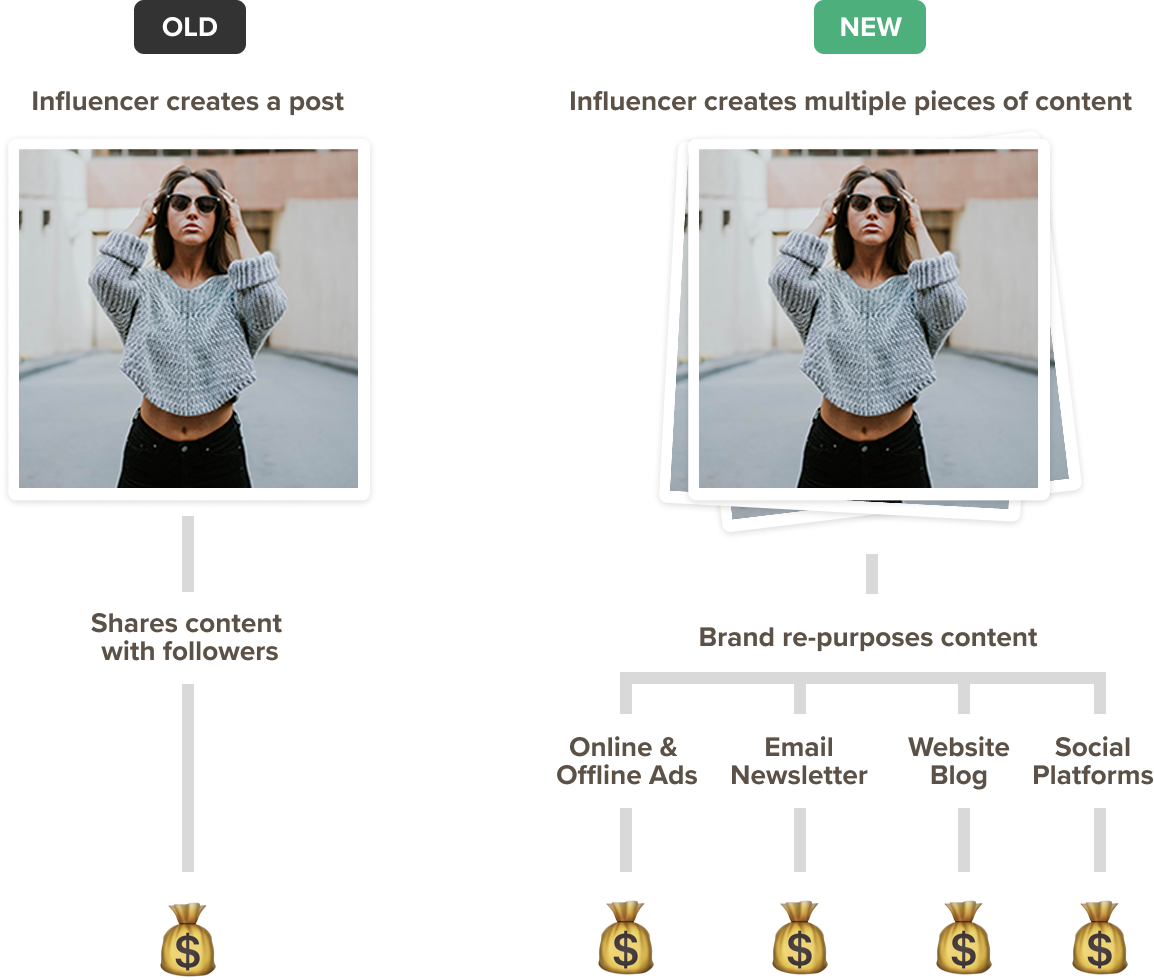
Content has worth beyond the reach of a single post — it can be repurposed into paid, owned, and earned channels. The new model accounts for that so small-but-real work doesn't read as worthless.
The result is a number that moves for the right reasons. For a lot of content it will come in lower than the old formula implied — and we think that's a feature, not a bug. An EMV you can defend line by line to a skeptical client is worth more than an inflated one that falls apart the first time someone asks how it was calculated. Credibility is the whole point of the metric.
06 The payoff
Earned media has always been worth something. The problem was never the value — it was making that value legible: measuring it honestly and explaining it plainly enough to stand behind. That's what we set out to fix: a number you can put in front of a client, a CFO, or a board and actually back up.
EMV was broken across the industry, and ours wasn't immune. Now it's something we're proud to put our name on — and something you can put yours on too.
See your EMV, rebuilt
See what defensible EMV looks like on your own numbers and across your whole influencer program.

Alicia Cofi
@aliciacofi

Earned Media Value
$27.4k
incl. asset value
Potential Reach
486k
Impressions
540k
$5.63 CPM
Engagements
12.4k
Media Posted
47
15 posts · 32 stories
Profiles Posted
15/31
Every step brand and agency teams take to go from zero to a live creator program in 30 days — strategy, outreach, briefing, approvals, launch, amplification, and reporting, all in one place.
MightyScout will send you this resource plus occasional content on influencer marketing and UGC. Unsubscribe anytime. Privacy Policy